
This rating reflects the technical complexity of the API mapping and logic required for this specific automation. It is designed to help you match this guide with your current skills.
The Verdict: Why Settle It is a Decisive SKIP
In the world of enterprise software, the most insidious costs are not on the invoice; they are hidden in the operational drag of inefficient processes. One of the most common is the high-latency, high-overhead task of group decision-making. This process, often relegated to chaotic email chains or unstructured messaging threads, creates a significant bottleneck, delaying projects and introducing ambiguity. The core problem is a classic I/O blocking issue: multiple, asynchronous human inputs must be manually aggregated, interpreted, and acted upon, a workflow ripe for error and inefficiency. This is the pain point Settle It aims to solve. It presents itself as a lightweight tool to force structured, quantifiable input (a simple poll) to deliver a clear, low-latency output (a decision).
However, the solution is as superficial as the problem is common. THE VERDICT: SKIP. This tool is the quintessential example of a minimalist feature masquerading as a standalone product. At its core, Settle It is a simple wrapper for a basic database write/read operation, fronted by a clean UI. While it effectively addresses a low-grade, universal annoyance, its feature set is profoundly shallow and possesses no defensible moat or significant barrier to entry. It is a transient utility—one you might use for a single, trivial decision and then immediately forget. It offers no ecosystem, no cumulative value, and no compelling reason for sustained operational reliance. The functionality it provides can be replicated with minimal effort inside the very collaboration platforms teams already use, such as Slack or Microsoft Teams. By forcing users into a separate, non-integrated tool, it introduces context-switching overhead, ironically adding a new layer of friction while trying to remove another.
What is Settle It? Architecture & Pricing
Settle It is a web-based application designed for creating and sharing simple polls via a link. The user types a question, shares a URL, and collects votes. There are no accounts, no setup, and according to its Product Hunt launch, it is free to use. Its technical stack is straightforward, utilizing modern, lightweight technologies like Tailwind CSS and Cloudflare for deployment, which speaks to its nature as a simple, fast-loading web utility.
From an architectural standpoint, Settle It is a Monolithic Walled Garden. This is not inherently negative for a simple tool, but it is a critical flaw for any solution aspiring to be part of a larger business workflow. The architecture is entirely self-contained, with all value locked within its front-end interface. There are no observable endpoints for automation. Our analysis found no evidence of a RESTful API, no webhooks to signal event completions (e.g., a “poll_completed” event), and absolutely no mechanism for third-party systems to programmatically create polls or retrieve results. This makes the tool a dead-end for any serious automation or integration strategy. An API-first approach would have exposed its core logic as scalable endpoints, allowing developers to integrate its decision-making function into project management dashboards, event-planning bots, or internal wikis. Instead, what we have is a disposable UI, not a scalable service. This architectural choice fundamentally limits its utility in a professional context and defines it as a consumer-grade feature, not an enterprise-ready platform.
Strategic Comparison: Settle It vs. The Market
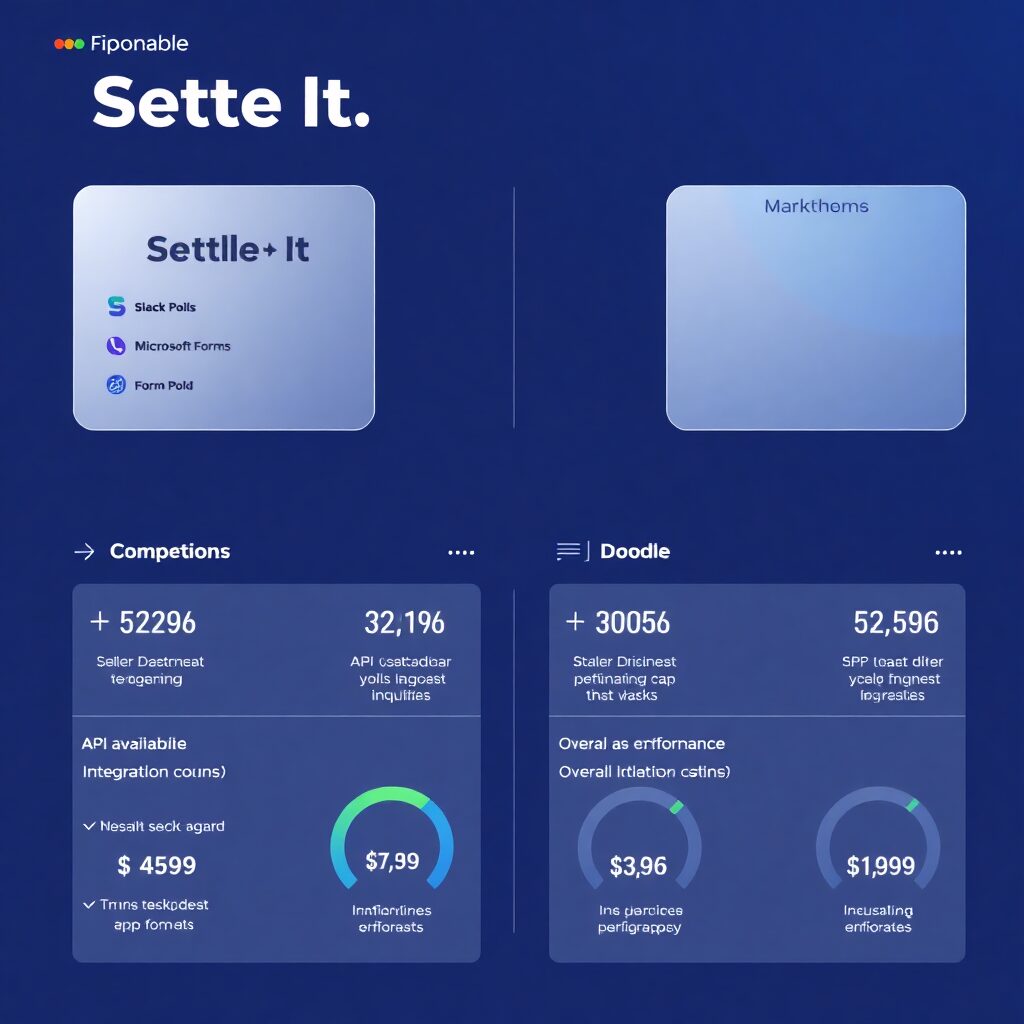
Figure: Strategic Automation Architecture for Settle It
To evaluate the strategic value of Settle It, we must compare it not to other standalone polling products, but to the integrated features that already exist within dominant collaboration ecosystems. The primary competitors are not other niche websites, but the native polling functions within Slack, Microsoft Teams (via Microsoft Forms integration), and the widely used scheduling tool, Doodle, which also solves group consensus problems.
These alternatives thrive on a simple principle: workflow integration. A poll created within a Slack channel or a Teams chat requires zero context switching. The request, the vote, and the result all occur within the same environment where the work is already happening. This is a massive architectural advantage. By living outside these core platforms, Settle It introduces friction. A user must leave their primary communication hub, navigate to a separate website, create the poll, copy the link, return to the hub, and paste it. While seemingly minor, this multi-step process is a significant barrier to adoption in fast-paced environments and is precisely the kind of operational drag that sophisticated teams work to eliminate.
The Comparison Matrix (Decision Guide)
| Feature | Settle It | Slack (Native Polls / Polly) | Microsoft Teams (via Forms) | Doodle |
|---|---|---|---|---|
| API & Webhooks | None | Yes (via apps like Polly) | Yes (via Microsoft Graph API) | Yes (Limited API for enterprise) |
| Workflow Integration | None (External link sharing only) | Native, in-channel experience | Native, in-chat/channel experience | External, but integrates with calendars |
| Context Switching | High | None | None | Medium |
| Use Case | Trivial, non-critical decisions | Team feedback, quick decisions | Formal surveys, team polls | Scheduling consensus |
| Pricing Model | Free | Included in Slack plan (or Freemium for apps) | Included in Microsoft 365 plan | Freemium / Paid Plans |
| Scalability | Low (No automation potential) | High (Programmable via APIs) | High (Programmable via APIs) | Medium (Enterprise integration) |
Technical Implementation with Make.com
A core tenet of modern system architecture is automation. The ability to connect disparate systems via APIs is what separates a disposable tool from a scalable solution. This is where the case against Settle It becomes undeniable. Due to its complete lack of an API, direct automation with a platform like Make.com is impossible. There is no endpoint to call to create a poll, no webhook to receive when a poll is completed, and no way to extract results programmatically. This platform is an island, and for a systems architect, islands are liabilities.
To illustrate the missed opportunity, let’s consider a hypothetical scenario where Settle It was built with an API-first approach. A standard automation workflow in Make.com would look like this:
- Trigger: A new message is posted in a specific Slack channel containing the phrase “/settleit”.
- JSON Mapping: The Make.com scenario would parse the Slack message content. For example, a message like “/settleit Where should we order lunch? Pizza, Tacos, or Salads” would be broken down. The question and options would be mapped to a JSON payload: `{“question”: “Where should we order lunch?”, “options”: [“Pizza”, “Tacos”, “Salads”], “channel_id”: “C12345”}`.
- API Call: An HTTP module would make a POST request to a hypothetical `https://api.settleit.com/v1/polls` endpoint, with the JSON payload as the body and an authentication token in the header.
- Webhook Listener: A separate Make.com scenario would be configured with a Webhook module, providing a unique URL. This URL would be registered with our hypothetical Settle It API to receive notifications. When the poll is complete, the tool would send a POST request to the webhook with the results.
- Error Handling: For the API call, an error handler with an “Ignore/Resume” directive would be crucial. If the API returns a 400 (Bad Request) or 500 (Server Error), the scenario could be configured to either halt and log the error or send a notification back to the original Slack channel informing the user of the failure, then gracefully resume waiting for the next trigger.
- Action: Upon receiving the results via the webhook, the scenario would format a message and post it back to the originating Slack channel, closing the decision loop automatically.
This entire, powerful workflow is impossible with the current architecture of Settle It. This isn’t just a missing feature; it’s a fundamental design flaw that relegates the tool to manual, one-off use cases and prevents it from ever becoming a part of an efficient, automated system.
Top 3 Alternatives
- Polly for Slack/Teams: Polly is a purpose-built application for polling within collaboration hubs. It offers a rich feature set, templates, and most importantly, deep integration. It lives where your team works, eliminating context switching entirely. Its API and workflow builder integrations make it a truly scalable solution for gathering team feedback.
- Microsoft Forms: For organizations embedded in the Microsoft 365 ecosystem, Forms is the logical choice. It allows for the creation of simple polls or complex surveys that can be deployed directly within Teams channels. The data is centrally managed, and the Microsoft Graph API provides robust endpoints for automating creation and result aggregation.
- Doodle: While primarily known for scheduling, Doodle’s core function is finding group consensus. It is more structured than Settle It and integrates directly with user calendars, solving a more complex and higher-value problem. For decisions related to time and availability, it remains a market leader.
This analysis evaluates Settle It in isolation. It does NOT account for your specific team size, automation debt, migration time, or hidden operational costs.
Most SaaS failures don’t come from choosing the wrong tool. They come from switching without calculating the real switching cost.
If Settle It is currently under consideration for your stack, the next step is not more research. The next step is cost validation.
Conclusion & Advanced Resources
In conclusion, Settle It is a well-executed but strategically flawed tool. It solves a real problem but does so in a way that ignores the modern imperative for integration and automation. Its lack of an API makes it a non-starter for any serious business application. The cumulative debt incurred by using such a tool is not technical, but operational; it reinforces a manual, disjointed workflow rather than streamlining it. The problem it highlights—the need for low-latency decision-making—is valid, but the solution is not to adopt another standalone feature. The correct architectural decision is to leverage and extend the capabilities of your core, integrated collaboration platforms.
For teams serious about building scalable, automated workflows, the foundation is a powerful integration platform. You can Start with Make.com to connect your existing tools and eliminate the manual overhead that tools like Settle It fail to address.
For those who require pre-built, advanced automation blueprints and strategies for complex systems integration, we recommend exploring the resources at GetAutomationFlow.com.
Transparency Disclosure: This guide contains affiliate links. If you register or purchase through these links, ToolALT may earn a commission at no additional cost to you. This helps us continue to provide high-quality, technical automation research.